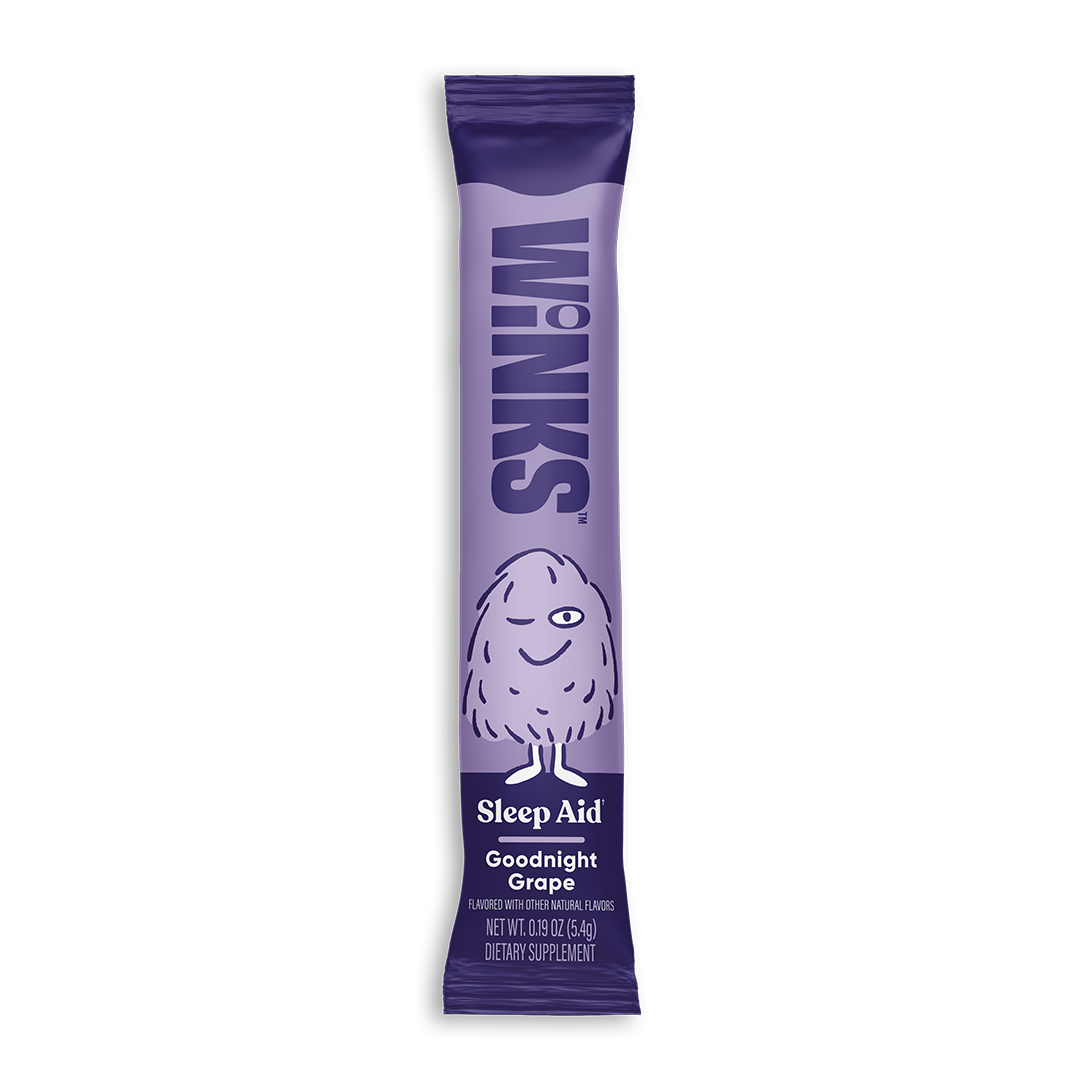
There is a bottle in the cupboard nobody has ever read the back of.
I'm Curtis. I founded Winks — a melatonin-free sleep powder formulated with input from a sleep researcher — so I have a side in this, and I would rather show my work than ask you to forget I have one. This page is written for adults.
You read the back before the front. You have stood in an aisle comparing two panels, slightly unhinged about it, and caught a product out at least once. And in a lot of houses there is one bottle that has never been through that: melatonin, bought once, by one person, for a reason, and still there for no reason in particular.
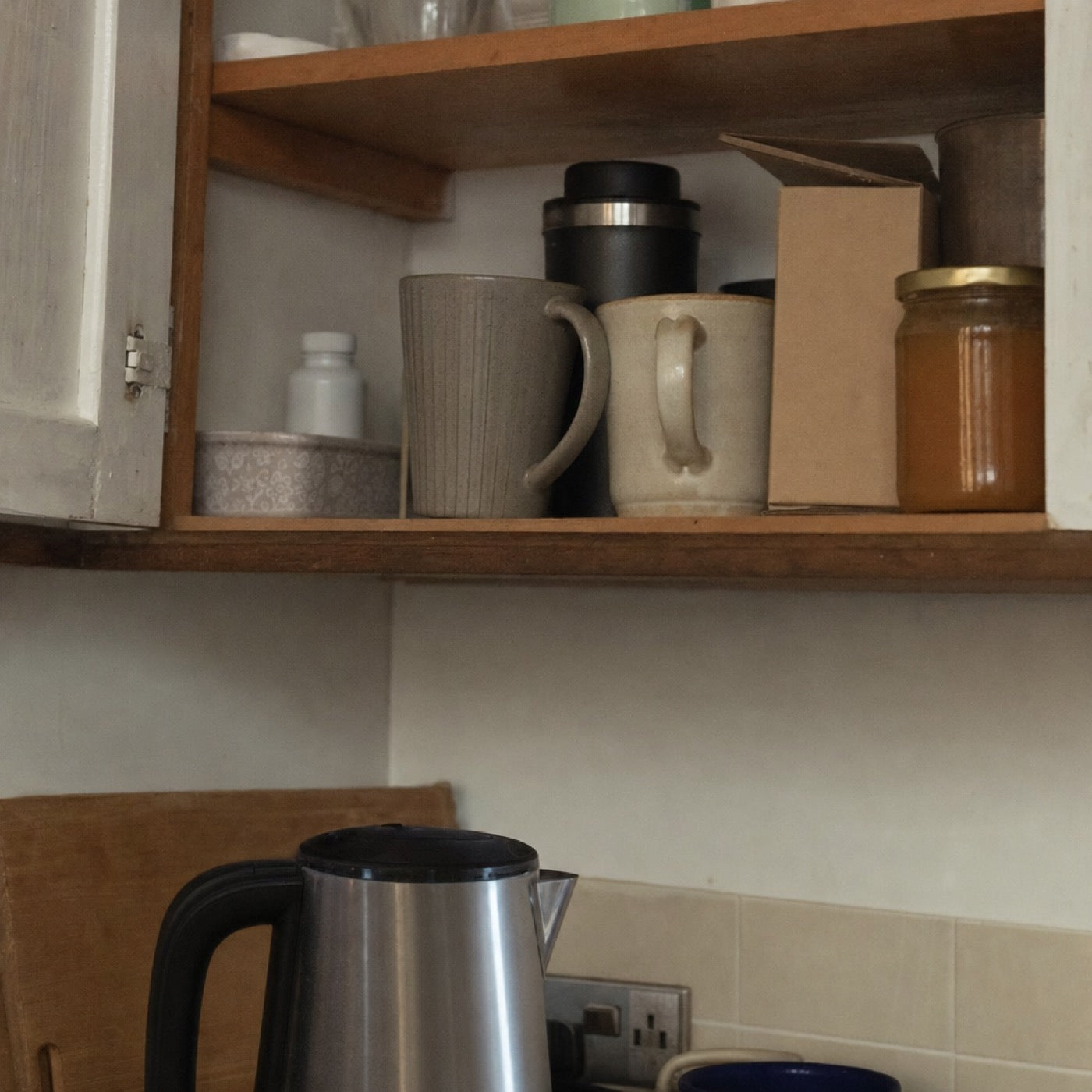
It was bought as a timing tool. It became a nightly routine without anyone deciding.
Melatonin is a signal about time. Its most established use is a body clock in the wrong place — jet lag, a shift rotation — where the job is to tell the body that night arrived earlier than it thinks. That is a job with a beginning and an end.
Then look at how it gets used. Bought for a trip, or a bad fortnight. Worked well enough. Stayed. It quietly changed jobs — from a thing you reach for on a particular night into part of going to bed. Nobody decided that. It drifted, which is what things in cupboards do.
That is not a discipline failure. Nobody sold it with instructions.
A bottle that has sat in the house for years is what happens when a timing tool is merchandised like a nightly vitamin. Gummies, flavours, counts of ninety — the packaging language of daily, not for the week you are in Berlin. No leaflet, no pharmacist, nothing saying for how long. Nightly was implied, so nightly is what happened: a decision somebody else made, in a packaging meeting.

Three hundred nights of a decision nobody ever made.
Here is the part that actually stings, and it has nothing to do with how anybody sleeps. A thing you take twice a year gets four seconds of thought. A thing that goes into a body three hundred nights running is a different order of decision — and in plenty of houses it is the one on the shelf that got none at all. It arrived as a tool, stayed as a habit, and nothing marked the change. That is an odd feeling to sit with, and the only one this page asks for.

The question everybody arrives with, and the one I will not answer.
People want to know whether the thing in the cupboard is bad for them. I am the last person who should tell them, because I sell something that competes with it.
If I say it is, I have converted a worry into my revenue. If I say it is fine, I am still not neutral — just neutral in the direction that makes me look trustworthy. Either way it is a sales argument in a lab coat. The people who can answer have nothing to sell you: a pharmacist, or a doctor who can see your whole picture.
And what I do not have, just as plainly: no outcome study, no sleep statistic, no head-to-head, no trial of the finished formula. So here is the one thing I will claim, and it is a fact rather than an accusation.
Melatonin is a hormone. That makes it a message, not a material.
The thing in that bottle is a hormone — a molecule the body already makes on its own schedule, to tell the rest of itself what time it is. Not a vitamin. Not a mineral. Not a botanical.
That distinction is the whole of my point. Take a nutrient and something is handed over: a raw material the body was short of — the magnesium dinner did not supply. Take a hormone and no material arrives at all. Nothing is supplied: a hormone is an instruction, added to a signalling system already running on its own schedule. Those are categorically different things to be doing nightly for three years, and the aisle is arranged so nobody has to notice which they are doing.
And an evening asks for material. Ask anyone what has to happen between the last email and the light going off and you get the same four back:
- 1A mind still going has to quieten.
- 2A day's stress has to come down.
- 3A body braced since the alarm has to loosen.
- 4A mood sanded thin by everyone's small demands has to level out.
Not one of those is a question about what time it is. They are questions about what a person has been given to work with, and a signal about the hour answers none of them.
One thing sharpens it. When independent analyses have tested melatonin gummies against their own labels, the amount inside has repeatedly not matched the amount printed outside. An uncertain amount of a raw material is the smaller uncertainty; an uncertain amount of a message is uncertainty about the message itself.
Every shelf says "melatonin-free" now, which is exactly why it tells you nothing.
The claim I would most like to lean on has been made worthless by everybody else leaning on it. The words are now on gummies, powders, teas, patches and drops, including products from companies that built the category on melatonin. Leaving an ingredient out is free, so a boast about it is worth what it cost. And notice what kind of claim it is: a subtraction. A glass of water is melatonin-free; so is an empty canister. Taking the hormone out is the easy half. What goes in its place is the product.
What goes in its place is material, and all of it is printed.
Winks is not a message about what time it is. Nothing in it is a hormone, so nothing in it is talking to your body's clock at all. It is material rather than signal, printed one line at a time — and against the four things an evening asks for, four of those lines carry the function claims the pack itself makes.
Nobody wants a supplement. What you want is sleep — the ordinary kind you stop having opinions about, where the evening ends and the next thing is morning. No honest sentence can promise you that, so I will not. What I can do is show you what is in the canister and hand you the test I would run on somebody else's.
Built against the four things an evening asks for.
Against each of those four we stand behind one function line, in the plainest phrasing the rules allow, and nothing beyond it.
-
For a mind still going AlphaWave® L-theanine · 200 mg
L-theanine promotes nervous system relaxation.
-
For a day that does not end when the day ends Sensoril® ashwagandha · 125 mg
An adaptogen that helps support the body's normal response to everyday stress.
-
For a body braced since the alarm went off Magnesium bisglycinate · 100 mg
Magnesium bisglycinate supports relaxation and helps reduce tension.
-
For a mood sanded thin by the day Affron® saffron · 28 mg
A standardised saffron extract that helps support a positive mood.
These statements have not been evaluated by the Food and Drug Administration, and this product is not intended to diagnose, treat, cure or prevent any disease.
Ten lines, and not one of them a hormone.
Here are the ten active lines from the back of the canister — every form and standardisation included. One stick pack, 5.4 g, is a serving.
- Calciumas Calcium Citrate200 mg
- Magnesiumas Magnesium Bisglycinate100 mg
- Organic Tart Cherry Fruit PowderPrunus cerasus480 mg
- Organic Lemon Balm Leaf ExtractMelissa officinalis · standardized to min 1% rosmarinic acid300 mg
- AlphaWave® L-theanine200 mg
- Organic Passion Flower Aerial Parts ExtractPassiflora incarnata150 mg
- Sensoril® Ashwagandha Root and Leaf ExtractWithania somnifera125 mg
- Sunflower Phosphatidylserine 70%100 mg
- Affron® Saffron Stigma ExtractCrocus sativus · standardized to 3.5% Lepticrosalides®28 mg
- Lithiumas Lithium Orotate0.5 mg
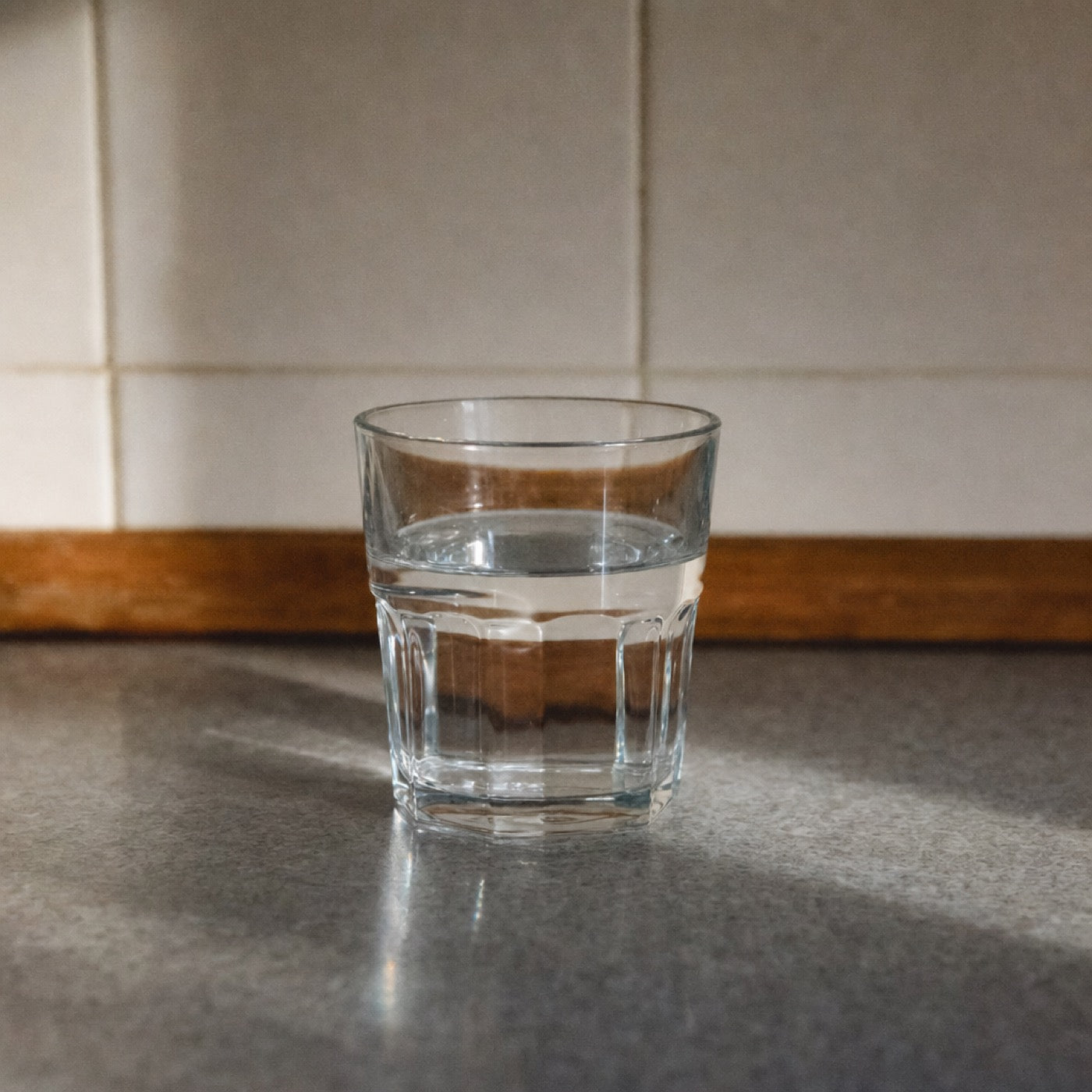
On a counter: one stick torn into a glass of water, grape. Thirty minutes before you are ready to sleep.
Two things decide whether a sleep formula is serious: which form, and how much.
Form first, and it is really one ingredient's argument. Magnesium is where the choice of form does the most work: magnesium citrate is the cheap way to get magnesium onto a label, and the form most likely to be felt in the bathroom rather than at bedtime. Ours is magnesium bisglycinate, and the panel says bisglycinate, because on that line the form is the part worth paying for.
Now the row that complicates my own test, before you find it yourself: our calcium is calcium citrate. Citrate is an ordinary, well-absorbed form of calcium, and the objection above is specific to magnesium rather than to the word. If you left believing citrate means cheap, you would run my own test on my own panel and it would fail for the wrong reason. A page that asks you to check things cannot skip the row that makes checking harder.
Then how much: ten lines, ten amounts, no line adding several ingredients into one total you cannot take apart. Three inputs are branded, standardised extracts — AlphaWave®, Sensoril®, Affron® — printed by trademark rather than plant name, because a standardised extract is a specific material and a plant name is only a category.
One more thing about our own panel.
Five of those ten lines carry no function claim from me. They are in the formula at their full printed amount, and I make no promise about any of them. Tart cherry is the one people ask about, being the ingredient the internet associates with melatonin: it is in there, at 480 mg, and I am still not going to tell you what it does.
One customer review exists. Here is exactly how we got it.
Not a wall of five-star praise. One review — and it was not from a stranger who paid.
I'M FINALLY SLEEPING THROUGH THE NIGHT!!! … i've been so excited to wake up and NOT see 3am on my clock every night! … not only does it keep me asleep, it helps me fall asleep too!
Katy received Winks free in the invitation round described above, and this is an excerpt. Her full review, unedited, is in the reviews section of the product page.
In August we gave fifty canisters away free to invited households, with a review request attached and one instruction: say what actually happened, including if nothing happened. Judge.me marks each of those reviews as collected by store invitation, so which is which is not our word — it is on the label of the review itself.
We could have written some instead. A page arguing that the category hides things behind claims you cannot check would refute itself by manufacturing proof. So the rule stands: real people, named, disclosed — the unflattering ones included.
One canister on the counter, not a bottle each.
Sleep is sold to one person and lived by everyone under the same roof.
The format is shared even though the units are not. Every stick is one person's single night and nobody splits one. But they come from one canister, one flavour, one order, instead of four bottles bought at four different times and never once compared. A bottle bought for one person's bad fortnight ends up in a kitchen everybody uses anyway. We would rather start from the kitchen.
The arithmetic is short. Twenty-eight stick packs, one a night, is four weeks for one person; two people is two canisters. So the buy box asks how many sleepers are in the house, not how many canisters — and the more there are, the less each one costs.

What it costs, plainly.
A canister is $65 on its own. On the routine it is $48 every four weeks — about $1.71 a night — and the price does not step up on renewal.
This costs many times what the bottle in the cupboard does, and I would rather say so here than have you work it out in the cart. A ninety-count of one hormone is a few dollars. This is ten dosed lines in a single-serve stick, three of them branded standardised extracts.
Buying for more sleepers steps the per-canister price down:
- 1 sleeper$48
- 2 sleepers$46 each
- 3 sleepers$44 each
- 4 sleepers$42 each
Renewals are the same price as the first delivery, and the buy box shows it in full before you order.
- Subscription: $48 every four weeks, first delivery and every one after it.
- One time: $65 plus shipping, with no subscription at all.
- Cancelling: skip, pause or cancel from your account before the next order. No calls, no emails.
The one-time option is the most expensive way to buy Winks, and the one that asks least of you.
Thirty nights, and we carry the risk instead of you.
Try it for thirty nights. If it is not for you, tell us inside that window and we will refund your first delivery — however many canisters it was — and stop anything scheduled after it. I would rather absorb the cost of the households it does not suit than ask them to carry it.
What you would actually be buying.
Melatonin is a hormone: a message about what time it is, and no material at all. Winks is the other kind of thing — the material, built against the same four an evening asks for, ten lines each with its own amount and not one of them a hormone.
One stick, cold water, grape. A canister on the counter rather than a bottle each. Thirty nights to decide, with the cost of being wrong carried by us.
Caution: this product may cause drowsiness. Do not drive, operate machinery or consume alcohol when using. Consult with a physician prior to use if you are pregnant or nursing, or taking any medication. Keep out of reach of children under the age of 4.
This formula contains a root-and-leaf ashwagandha extract. Some regulators advise that minors, and people with thyroid, liver or heart conditions, avoid ashwagandha; speak to a doctor before use.
These statements have not been evaluated by the Food and Drug Administration. This product is not intended to diagnose, treat, cure, or prevent any disease. Individual results may vary.